Context
Current recommendations regarding infant feeding advocate for exclusive breastfeeding during the first 6 months of life, or at least during the first 4 months. Furthermore, most international and national scientific societies recommend initiating complementary feeding at approximately 6 months of age. Nonetheless, several studies have shown high levels of non-compliance with these recommendations, particularly in France.
Formula-fed children are often considered a homogeneous group when compared to breastfed children. However, a wide variety of infant formulas are available on the market, notably in France, and the health and development of the child could be influenced by their nutritional composition: protein content, protein hydrolysis level, enrichment with long-chain polyunsaturated fatty acids (LCPUFAs), probiotics, or prebiotics (or both). Thus, the heterogeneity of the literature regarding the benefits of breastfeeding on child health (obesity, allergies, etc.) could be partly explained by inter-individual variations in the composition of breast milk (related to genetic or environmental factors), but also by heterogeneity in the diet of non-breastfed infants, such as the composition of infant formulas or foods consumed during complementary feeding. Indeed, complementary feeding could also influence growth and the development of allergies in children.
Objectives
In this context, InfaDiet is a collaborative project, which aimed at studying the influence of infant feeding (milk components & complementary feeding practices) on the child’s health (growth, infections and allergic symptoms) and neurodevelopment. Our main hypothesis was that the beneficial influence of breastfeeding on the child’s health and development is explained by nutritional components of breast milk but also by association of breastfeeding practices with specific complementary feeding practices, such as the more frequent use of fruit and vegetables. The recent evolution of formula milk composition (enrichment with long chain PUFA or with pre/probiotics) offered the opportunity to examine potential nutritional hypothesis, independently of breastfeeding-related practices. Furthermore, we proposed to explore breast milk composition, with large-scale non-targeted methods, already developed, to highlight specific components related to the child’s health and neurodevelopment. In this project, child health was be defined by height and weight growth, occurrence of infections and incidence of allergy-related diseases.
Project Organization and Outline
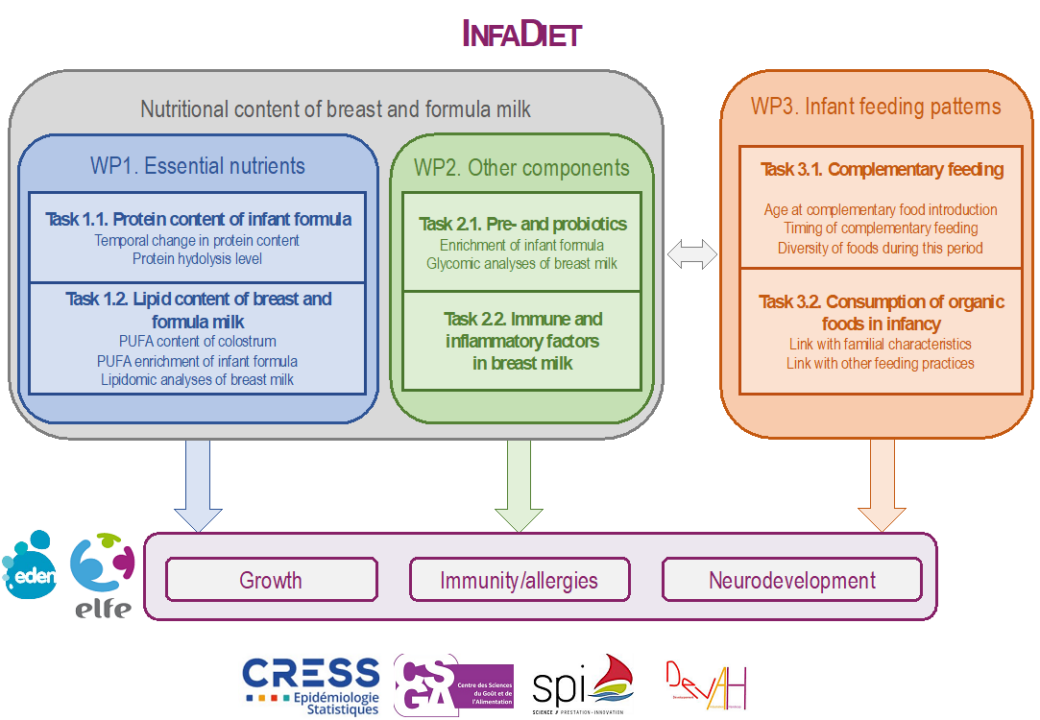
The project was divided into three work packages. The 1st work package was devoted to the influence of essential nutrients (lipids and proteins) in breast and formula milk on child’s health and development. The 2nd work package was devoted to other components, recently added into formula milk such as pre- and probiotics or only present in breast milk such as complex HMO, immune or inflammatory factors. Breast milk analyses were based on large-scale non-targeted (“omic”) methods. In the 3rd work package, we extended our approach to other aspects of infant feeding, such as timing and type of foods used during the complementary feeding period (including organic foods).
The project was based on two French birth cohorts: the regional EDEN cohort (2003–2006, n = 2002) and the nationwide ELFE cohort (2011, n = 18,329). These two cohorts enabled to analyse both short- and long-term health effects, but also to replicate analyses and assess the reproducibility of findings.
Results
We observed a decrease in the protein content of infant formulas between the EDEN study (2003-2006) and the ELFE study (2011). The pooling of data from these cohorts (Camier, 2021) confirmed, in real-world conditions, the results of the 2009 CHOP trial.
Infant formulas based on partially hydrolysed proteins (pHF) are offered with the aim of allergy prevention. Our results (Adjibade, 2024) show, in real-use conditions, that the consumption of pHF infant formulas is associated with a higher likelihood of multimorbid allergic conditions (eczema, food allergies, without asthma).
Before 2020, enrichment of infant formulas with long-chain polyunsaturated fatty acids (LC-PUFA) was not systematic. In the ELFE study, no association was found between this enrichment and cognitive, language, or motor development scores up to 3.5 years (Martinot, 2022). Conversely, an inverse association was observed between this enrichment and the frequency of lower respiratory infections (Adjibade, 2022).
In the EDEN study, approximately 25% of children consumed a formula enriched with pre- or probiotics; this figure was 56% in the ELFE study. In ELFE, the consumption at 2 months of a formula enriched with Bifidobacterium lactis was associated with a lower risk of respiratory illnesses in early childhood (Adjibade et al., 2022). In the EDEN cohort, it was associated with a lower risk of allergy (Adjibade et al., 2024). No clear association was found for formulas enriched solely with prebiotics.
In the ELFE study, among children without allergies at 2 months, late complementary feeding introduction (>6 months) was associated with a higher risk of food allergy. Similarly, delayed introduction of at least two allergens (among egg, fish, wheat, milk) after 10 months was linked to a higher risk of food allergy. Early complementary feeding (<4 months) was associated with a lower BMI in childhood but was not linked to an increased risk of overweight (Camier et al., 2024). Regarding neurodevelopment, we showed that late introduction of food pieces (beyond 10 months) was associated with lower neurocognitive development scores (Somaraki, 2024).
In the national ELFE study, 51% of infants had never consumed foods from organic farming during the complementary feeding period (up to 10 months), 24% sometimes, 15% often, and 9% always or almost always (de Lauzon-Guillain et al., 2021). Organic food consumption is more common among children breastfed for a long time, from more educated families, and often part of feedin practices perceived as “healthier” (home-made foods, lower consumption of sugary drinks), but also among families with a history of allergies (Payet et al., 2021).
Partners

Funding
The present study funded by an ANR grant (ANR-19-CE36-0008).

Publications
- Camier A, Chabanet C, Davisse-Paturet C, Ksiazek E, Lioret S, Charles MA, Nicklaus S, de Lauzon-Guillain B. Characterization of Infant Feeding Practices and Related-Family Characteristics in the French Nationwide ELFE Birth Cohort. Nutrients 2020;13(1). doi: 10.3390/nu13010033.
- Camier A, Davisse-Paturet C, Scherdel P, Lioret S, Heude B, Charles MA, de Lauzon-Guillain B. Early growth according to protein content of infant formula: Results from the EDEN and ELFE birth cohorts. Pediatr Obes 2021;16(11):e12803. doi: 10.1111/ijpo.12803.
- de Lauzon-Guillain B, Gaudfernau F, Camier A, Davisse-Paturet C, Lioret S, Nicklaus S, Charles MA, Kesse-Guyot E. Characteristics associated with feeding organic foods during complementary feeding: the nationwide Etude Longitudinale Francaise depuis l’Enfance (ELFE) birth cohort. Br J Nutr 2021;126(8):1215-24. doi: 10.1017/S0007114520005097.
- Payet D, Adjibade M, Baudry J, Ghozal M, Camier A, Nicklaus S, Adel-Patient K, Divaret-Chauveau A, Gauvreau-Beziat J, Vin K, et al. Organic Food Consumption During the Complementary Feeding Period and Respiratory or Allergic Diseases Up to Age 5.5 Years in the ELFE Cohort. Front Nutr 2021;8:791430. doi: 10.3389/fnut.2021.791430
- Adjibade M, Davisse-Paturet C, Bernard JY, Adel-Patient K, Divaret-Chauveau A, Lioret S, Charles MA, de Lauzon-Guillain B. Enrichment of infant formula with long-chain polyunsaturated fatty acids and risk of infection and allergy in the nationwide ELFE birth cohort. Allergy 2022;77(5):1522-33. doi: 10.1111/all.15137.
- Adjibade M, Davisse-Paturet C, Divaret-Chauveau A, Adel-Patient K, Raherison C, Dufourg MN, Lioret S, Charles MA, de Lauzon-Guillain B. Enrichment of Formula in Probiotics or Prebiotics and Risk of Infection and Allergic Diseases up to Age 5.5 Years in the Nationwide Etude Longitudinale Francaise depuis l’Enfance (ELFE) Cohort. J Nutr 2022;152(4):1138-48. doi: 10.1093/jn/nxac013.
- Camier A, Cisse AH, Lioret S, Bernard JY, Charles MA, Heude B, de Lauzon-Guillain B. Infant feeding practices associated with adiposity peak and rebound in the EDEN mother-child cohort. Int J Obes (Lond) 2022;46(4):809-16. doi: 10.1038/s41366-021-01059-y.
- Delvert R, Ghozal M, Adel-Patient K, Kadawathagedara M, Heude B, Charles MA, Annesi-Maesano I, Tafflet M, Leynaert B, Varraso R, et al. Maternal Diet Quality during Pregnancy and Allergic and Respiratory Multimorbidity Clusters in Children from the EDEN Mother-Child Cohort. Nutrients 2022;15(1). doi: 10.3390/nu15010146.
- Martinot P, Adjibade M, Taine M, Davisse-Paturet C, Lioret S, Charles MA, de Lauzon-Guillain B, Bernard JY. LC-PUFA enrichment in infant formula and neurodevelopment up to age 3.5 years in the French nationwide ELFE birth cohort. Eur J Nutr 2022;61(6):2979-91. doi: 10.1007/s00394-022-02863-6.
- Tamazouzt S, Adel-Patient K, Deschildre A, Roduit C, Charles MA, de Lauzon-Guillain B, Divaret-Chauveau A. Prevalence of Food Allergy in France up to 5.5 Years of Age: Results from the ELFE Cohort. Nutrients 2022;14(17). doi: 10.3390/nu14173624.
- Adam T, Divaret‐Chauveau A, Roduit C, Adel‐Patient K, Deschildre A, Raherison C, Charles MA, Nicklaus S, de Lauzon‐Guillain B. Complementary feeding practices are related to the risk of food allergy in the ELFE cohort. Allergy 2023. doi: 10.1111/all.15828.
- Marinho AR, Correia D, Bernard JY, Heude B, Lopes C, de Lauzon-Guillain B. Macronutrient intake during infancy and neurodevelopment in preschool children from the EDEN mother-child cohort. Eur J Clin Nutr 2023. doi: 10.1038/s41430-023-01273-z.
- Somaraki M, de Lauzon-Guillain B, Bernard JY, Tafflet M, Charles MA, Nicklaus S. Hydrolysed proteins in infant formula and child neurodevelopment up to the age of 3.5 years: the nationwide Etude Longitudinale Francaise depuis l’Enfance (ELFE) birth cohort. Br J Nutr 2023:1-12. doi: 10.1017/S0007114523000211.
- Camier A, Cisse AH, Heude B, Nicklaus S, Chabanet C, Bernard JY, Lioret S, Charles MA, de Lauzon-Guillain B. Infant feeding practices and body mass index up to 7.5 years in the French nationwide ELFE study. Pediatr Obes 2024:e13121. doi: 10.1111/ijpo.13121.
- Delvert R, Charles MA, Leynaert B, Kadawathagedara M, Adel-Patient K, Divaret-Chauveau A, et al. Maternal diet quality with child allergic and respiratory multimorbidity in the Elfe birth cohort. Sci Rep. 2024;14(1):13048. doi: 10.1038/s41598-024-63456-3.
- Delvert R, Dow C, Charles MA, Adel-Patient K, Divaret-Chauveau A, Dufourg MN, et al. Is an antioxidant-rich or a pro-inflammatory diet during pregnancy associated with allergic and respiratory multimorbidity in children from the ELFE birth cohort? Br J Nutr. 2024;132(10):1356-64. doi: 10.1017/S0007114524002642.
- Somaraki M, de Lauzon-Guillain B, Camier A, Bernard JY, Tafflet M, Dufourg MN, Charles MA, Chabanet C, Tournier C, Nicklaus S. Timing of food pieces introduction and neurodevelopment: findings from a nationwide birth cohort. Int J Behav Nutr Phys Act. 2024;21(1):118. doi: 10.1186/s12966-024-01669-5.