Identifying a fitness tool in early old-age to predict long-term risk of disability, severe disability, and mortality
Population ageing has led to an increase in prevalence of old-age disability but whether the risk of disability can be detected early remains unclear.
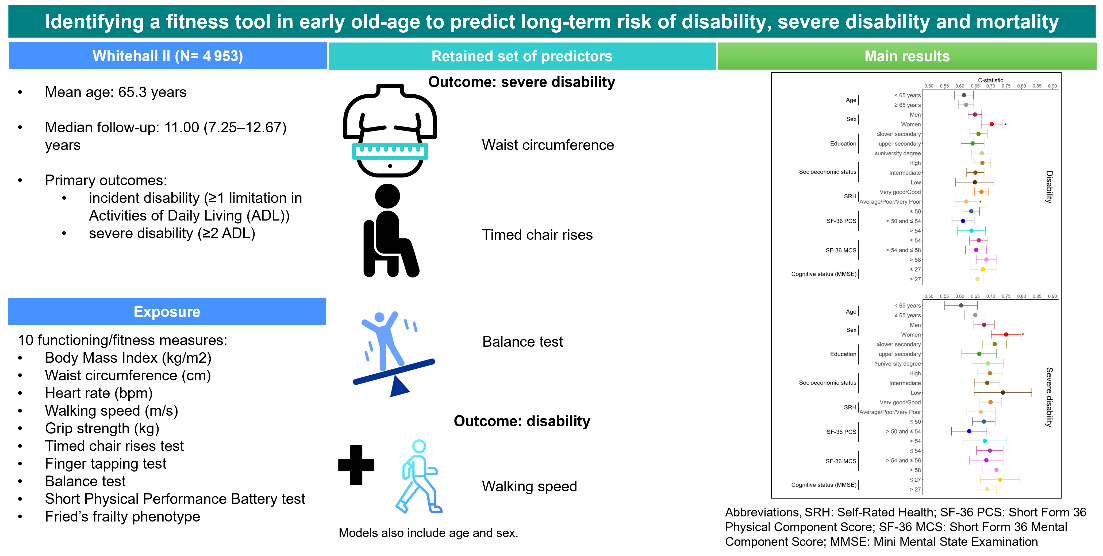
We used ten functioning/fitness measures in early old-age to identify their predictive ability for disability at older ages. A total of 4593 participants of the Whitehall II study, mean age 65.3 years, were followed for a median of 11.00 (IQR 7.25–12.67) years for incident disability [≥ 1 limitation in activities of daily living (ADL)], and severe disability (≥ 2 ADL). We first examined whether the C-statistic for each predictor, considered individually, improved the C-statistic of a model containing age and sex. We then used LASSO regression, using decrements of 0.0001 in a step-wise manner in the lambda regularization parameter to select the most important predictors. Improvement in C-statistic of a new set of LASSO predictors was tested to select the final set of predictors. Among the functioning/fitness measures considered individually, waist circumference had the highest C-statistic for disability [0.6557, 95% confidence interval (CI) 0.6367–0.6747] and severe disability (0.6868, 0.6582–0.7153). The best set of LASSO predictors (0.6617, 0.6431–0.6804) for incident disability included age, sex, waist circumference, walking speed, timed chair rises, and balance. For severe disability, the predictors were the same without walking speed (0.6955, 0.6678–0.7233).
Our findings highlight the importance of obesity measures for risk of disability, and show that a small set of functioning/fitness measures can be useful in identifying individuals at higher risk of disability at older ages.
By Céline Ben Hassen, Aurore Fayosse, Damien Vitiello, Pauline Maillot, Benjamin Landré, Ian Meneghel Danilevicz, Séverine Sabia, Archana Singh-Manoux