Overall and population-based assessment of severe maternal morbidity:
incidence, determinants, quality of care
Objectives
The overall objective of the EPIMOMS project is to provide answers to both methodological and substantive questions that are currently unresolved related to the study of severe maternal morbidity and to obtain data characterizing France and allowing international comparisons.
The EPIMOMS project has 7 specific objectives:
- To propose a consensus definition of severe maternal morbidity appropriate to the objective of increasing knowledge.
- To measure the incidence of severe maternal morbidity in the general population in France, both overall and for its principal components.
- To study the quality of severe maternal morbidity-related information in the hospital discharge statistics (PMSI) and propose a definition allowing it to be monitored from this permanent database.
- To identify the factors that increase the risk of severe maternal morbidity, including the characteristics of individual women, obstetric care before the onset of severe morbidity and the delivery hospitals, as well as the interactions between these factors.
- To design an early alert tool for severe maternal morbidity, to predict whether a severe morbid event will have an unfavorable course, toward a “near-miss” or death.
- To propose a method for assessing the quality of care of severe maternal morbid events.
- To measure the quality of care provided in severe maternal morbidity events in France today and to identify potential improvements.
Methods
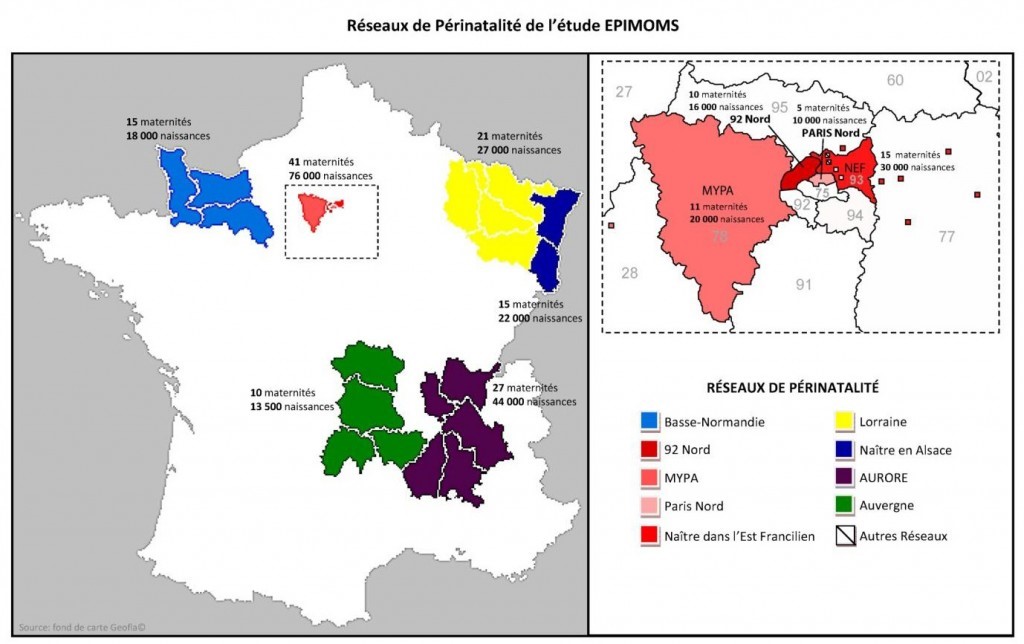
EPIMOMS is a population-based study conducted in 9 perinatal networks in France (6 regions) (Figure 1) from May 2012 to April 2013.
It included:
- all women with a severe morbid event according to the definition selected (by a formalized expert consensus process) from the 22nd week of pregnancy to the 42nd day after delivery, and hospitalized in a facility in one of the participating areas, that is 2540 women, and
- a sample of 1/50th (2%) of the women who gave birth (at a term of at least 22 weeks) without a severe morbid event in one of the participating maternity units, that is, 3651 women
Cases were identified from all the maternity units, adult intensive care units, emergency departments, and mother-baby units in the areas participating.
The data collected covered social and demographic characteristics, medical and obstetric history, the course of the pregnancy and delivery, and a description of the morbid event and its management. Information about the characteristics and organization of the maternity units was also collected by a specific questionnaire.
Figure 1: Regions participating in the EPIMOMS study
Organization
EPIMOMS is a collaboration between the Inserm EPOPé team, 9 perinatal networks, the French Society for Anesthesiology and Critical Care Medicine (SFAR), and the Pôle IMER (medical information and research evaluation) of the Hospices Civils de Lyon.
The EPIMOMS study received funding from the ANR white program in 2010 (440 K €), and the Ile de France regional health agency (65 K €).
EPIMOMS Steering Committee
Inserm U 1153, EPOPé team, coordination: Catherine Deneux-Tharaux (Study director), Anne Chantry, Aurélien Seco (statistician).
Elie Azria (Paris Nord perinatal network), Nathalie Baunot (Naître dans l’Est Francilien perinatal network), Marie-Pierre Bonnet (Société Française d’Anesthésie Réanimation, Inserm 1153) , Gaël Beucher (Basse-Normandie perinatal network), Cyrille Colin (Hospices Civils de Lyon, pôle IMER), Catherine Crehn-Hébert (92 Nord perinatal network), Michel Dreyfus (Basse-Normandie perinatal network), Corinne Dupont (Aurore perinatal network), Jeanne Fresson (Lorraine perinatal network), Nathalie Hochin (Paris Nord perinatal network), Gilles Kayem (Inserm U1153, 92 Nord perinatal network), Bruno Langer (Naître en Alsace perinatal network), Alexandre Mignon (Société Française d’Anesthésie Réanimation), Patrick Rozenberg (Maternités en Yvelines et Pays Associés perinatal network) , René-Charles Rudigoz (Aurore perinatal network), Françoise Vendittelli (Auvergne perinatal network).
Contact
epimoms@inserm.fr
Recent publications
- Salvi S, Mandolini D, Bloemenkamp KWM, Deneux-Tharaux C, Engjom HM, Kodan LR, Korb D, Krištúfková A, Klungsøyr K, Langedock A, Mentzoni CT, McCullough L, Ramakrishnan R, Schaap TPT, Seco A, Vandenberghe G, Verschueren KJC, Donati S; INOSS Group (International Network of Obstetric Survey Systems). Eclampsia Incidence, Management and Outcomes Across Multi-Country Surveillance Cohorts: Individual Participant Data Meta-Analysis. BJOG. 2026 Mar 26.
- Korb D, Azria E, Sauvegrain P, Carbillon L, Langer B, Seco A, Chiesa-Dubruille C, Bouvier-Colle MH; Epimoms study group; Deneux-Tharaux C. Population-based study of eclampsia: Lessons learnt to improve maternity care. PLoS One. 2024 May 2;19(5):e0301976.
- Chantry Aa,Peretout P, Chiesa-Dubruille C, Crenn-Hébert C, Vendittelli F, Le Ray C, Deneux-Tharaux C; EPIMOMS study group. Peripartum severe acute maternal morbidity in low-risk women: A population-based study. Midwifery. 2023 Apr;119:103602.
- Didelot H, Goffinet F, Seco A, Deneux-Tharaux C; EPIMOMS (EPIdémiologie de la MOrbidité Maternelle Sévère) Study Group. Evaluating the quality of care for postpartum hemorrhage with a new quantitative tool: a population-based study. Sci Rep. 2022 Nov 3;12(1):18626.
- Deleu F, Deneux-Tharaux C, Chiesa-Dubruille C, Seco A, Bonnet MP; EPIMOMS study Group. Fibrinogen concentrate and maternal outcomes in severe postpartum hemorrhage: A population-based cohort study with a propensity score-matched analysis. J Clin Anesth. 2022 Oct;81:110874.
- Godeberge C, Deneux-Tharaux C, Seco A, Rossignol M, Chantry AA, Bonnet MP; EPIMOMS Study Group. Maternal Intensive Care Unit Admission as an Indicator of Severe Acute Maternal Morbidity: A Population-Based Study. Anesth Analg. 2022 Mar 1;134(3):581-591.
- Raineau M, Deneux-Tharaux C, Seco A, Bonnet MP; EPIMOMS Study Group. Antepartum severe maternal morbidity: A population-based study of risk factors and delivery outcomes. Paediatr Perinat Epidemiol. 2022 Mar;36(2):171-180.
- Kallianidis AF, Maraschini A, Danis J, Colmorn LB, Deneux-Tharaux C, Donati S, Gissler M, Jakobsson M, Knight M, Kristufkova A, Lindqvist PG, Vandenberghe G, van den Akker T; INOSS (the International Network of Obstetric Survey Systems). Management of major obstetric hemorrhage prior to peripartum hysterectomy and outcomes across nine European countries. Acta Obstet Gynecol Scand. 2021 Jul;100(7):1345-1354.
- Guignard J, Deneux-Tharaux C, Seco A, Beucher G, Kayem G, Bonnet MP; EPIMOMS group. Gestational anaemia and severe acute maternal morbidity: a population-based study. Anaesthesia. 2021 Jan;76(1):61-71.
- McCall SJ, Henriquez D, Edwards HM, van den Akker T, Bloemenkamp KWM, van der Bom J, Bonnet MP, Deneux-Tharaux C, Donati S, Gillissen A, Kurinczuk JJ, Li Z, Maraschini A, Seco A, Sullivan E, Stanworth S, Knight M. A total blood volume or more transfused during pregnancy or after childbirth: Individual patient data from six international population-based observational studies. PLoS One. 2021 Jan 22;16(1):e0244933.
- Deleu F, Deneux-Tharaux C, Chiesa-Dubruille C, Seco A, Bonnet MP; EPIMOMS study group (see Appendix). A population-based analysis of French transfusion practices for women experiencing severe postpartum hemorrhage. Int J Obstet Anesth. 2020 May;42:11-19.
- Madar H, Goffinet F, Seco A, Rozenberg P, Dupont C, Deneux-Tharaux C. Severe Acute Maternal Morbidity in Twin Compared With Singleton Pregnancies. Obstet Gynecol. 2019 May 9. doi: 10.1097/AOG.0000000000003261
- Korb D, Goffinet F, Chevret S, Seco A, Deneux-Tharaux C. Risk of severe maternal morbidity associated with cesarean delivery and the role of maternal age: a population-based propensity score analysis. CMAJ. 2019 Apr 1;191(13):E352-E360.
- Le Ray C, Pelage L, Seco A, Bouvier-Colle MH, Chantry A, Deneux-Tharaux C. Risk of severe maternal morbidity associated with in vitro fertilisation: a population-based study. 2019 Mar 27. doi: 10.1111/1471-0528.15668
- Siddiqui A, Azria E, Howell EA, Deneux-Tharaux C. Obesity and the risk of severe acute maternal morbidity: findings from the French EPIMOMS population-based study. Paediatr Perinat Epidemiol. 2019 Jan;33(1):7-16.
- Vandenberghe G, Bloemenkamp K, Berlage S, Colmorn L, Deneux-Tharaux C, Gissler M, Knight M, Langhoff-Roos J, Lindqvist PG, Oberaigner W, Van Roosmalen J, Zwart J, Roelens K; INOSS (the International Network of Obstetric Survey Systems). The International Network of Obstetric Survey Systems study of uterine rupture: a descriptive multi-country population-based study. BJOG. 2019 Feb;126(3):370-381. doi: 10.1111/1471-0528.15271.