Background
Reducing the consumption of food of animal origin is a major environmental, public health and economic challenge. However, plant-based diets may lead to some nutritional deficiencies insofar as certain essential nutrients are only present in small quantities in plants.
Objective
In this context, VegPregnancy aims at studying the influence of plant-based diet during pregnancy on both mother’s and child’s health, and to explore potential intermediate factors to help elucidate associated mechanisms.
Project Organization and Outline
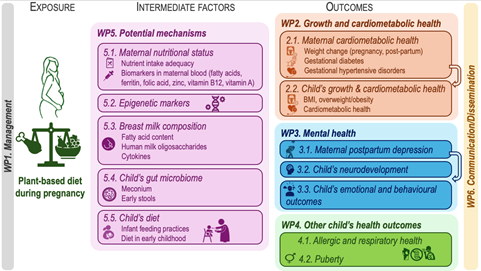
The project is based on four complementary birth cohorts: ELFE (n=18,329), EDEN (n=2002), SEPAGES (n=484) and VEGALIM (n~600); and one adult cohort: NutriNet-Santé (8500 pregnancies reported during follow-up). A 1st part will be devoted to the influence of plant-based diet during pregnancy and maternal cardiometabolic health and child’s growth and cardiometabolic health. A 2nd part will be devoted to maternal postpartum depression and child’s cognitive and behavioural development. A 3rd part will focus on child’s allergic and respiratory health and, then, puberty. A large part of VegPregnancy will examine, on a sub-sample within each cohort, whether some biological markers (or feeding practices) are related to plant-based diet during pregnancy and could be considered as mediating factors between plant-based diet during pregnancy and both mother’s and child’s outcomes. We will consider biomarkers of maternal nutritional status, placental epigenetic patterns, breastmilk composition (fatty acids, human milk oligosaccharides, cytokines) and gut microbiome in early childhood.
Partnership
Multidisciplinary, VegPregnancy associates complementary expertise: epidemiology, immunology, microbiota, epigenetic, nutrition, mental health, respiratory health.





Founding
ANR (ANR25-CE36-6175)